
Why do geckos stick to walls?
The Real Answer
Geckos can stick to walls because the bottoms of their toes are covered with enormous numbers of microscopic hair-like structures called setae. Each seta branches into even smaller contact structures, often called spatulae, allowing the toe pad to make extremely close contact with a surface.
At that tiny scale, intermolecular attractions known as van der Waals forces become strong enough across all those contact points to create substantial adhesion. A gecko is therefore not using glue or suction cups; its feet rely on microscopic structure and very close surface contact.
The system is also reversible. By changing the angle and direction of the toes, a gecko can engage or release the adhesive contact rapidly as it runs. Real-world performance can also be affected by factors such as surface material, humidity, toe-pad structure, and the forces created by the animal’s movement, so the mechanism is more sophisticated than simply saying “van der Waals forces make it stick.”
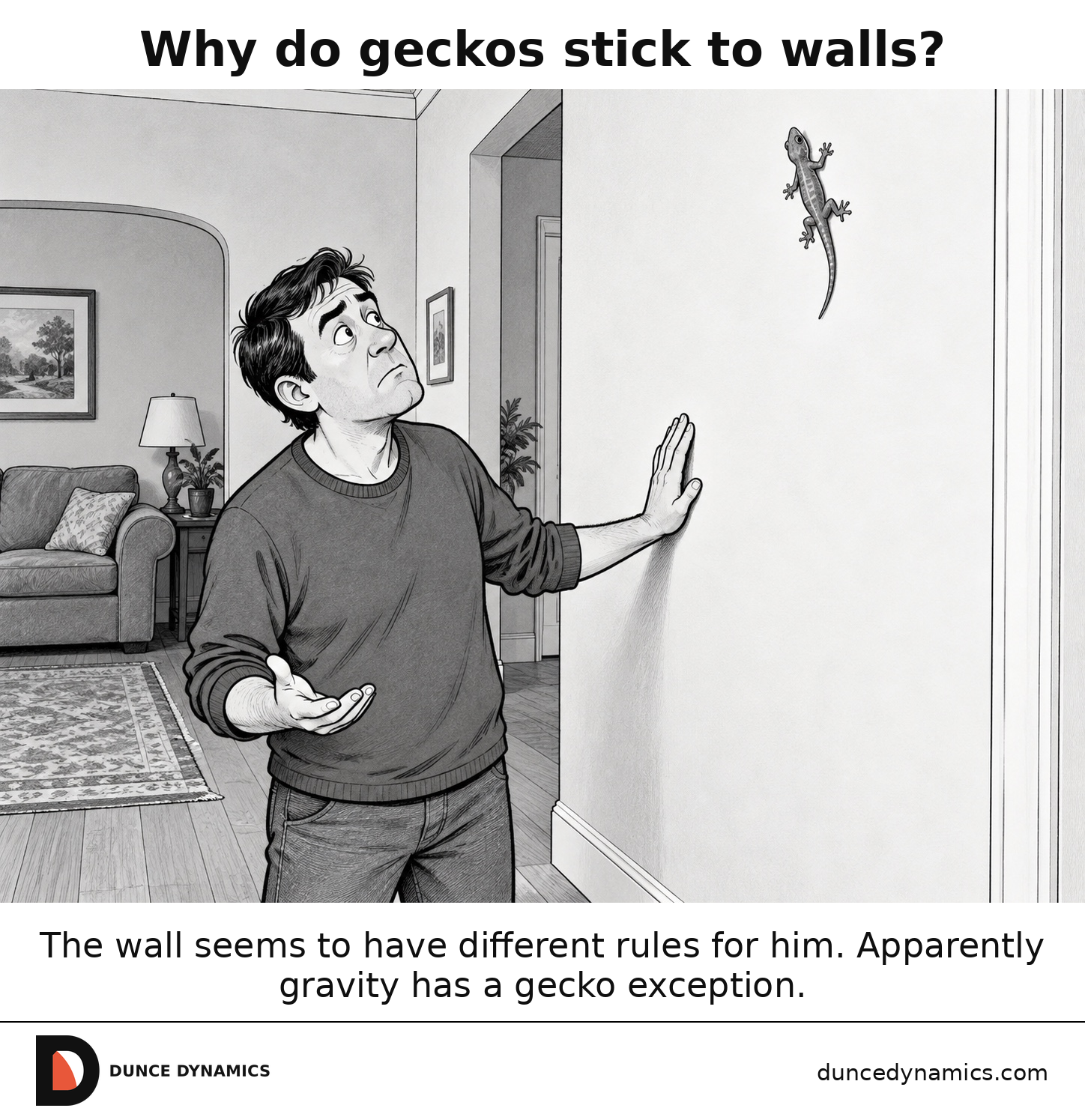
A gecko can run straight up a wall with dry feet, no glue, and no visible effort. You hang one picture with a stud finder, anchors, a level, three different screws, and still spend the next week checking whether it looks crooked.
The Dunce Dynamics Institute Examines Why People Ask This
People ask because a gecko can walk across vertical walls and even ceilings while appearing to place ordinary-looking feet directly on the surface. Since there is no obvious adhesive, clawing, or suction mechanism visible from a distance, the ability can look almost impossible until the microscopic structure of the toe pads is explained.