
Why do people add 'P.S.' at the end of a message?
The Real Answer
People add P.S. when they want to include an additional note after the main message has effectively been completed. The abbreviation stands for postscript, from a term meaning something written afterward.
The convention made especially obvious sense with handwritten and typewritten letters. If you had already finished and signed a letter, adding a short note at the bottom was much easier than rewriting the entire page just because you remembered one more thing.
Digital messages can be edited before they are sent, so a postscript is no longer technically necessary in the same way. But the convention has survived because people recognize it immediately as an added thought or separate final note. Modern writers may use it simply because that format suits what they want to add; there is no single universal reason every person uses a P.S.
You spend ten minutes writing an email, sign your name, then remember the one thing you actually needed to say and add it under “P.S.” The recipient skips straight to it, which is efficient because that was apparently the part you should have written first.
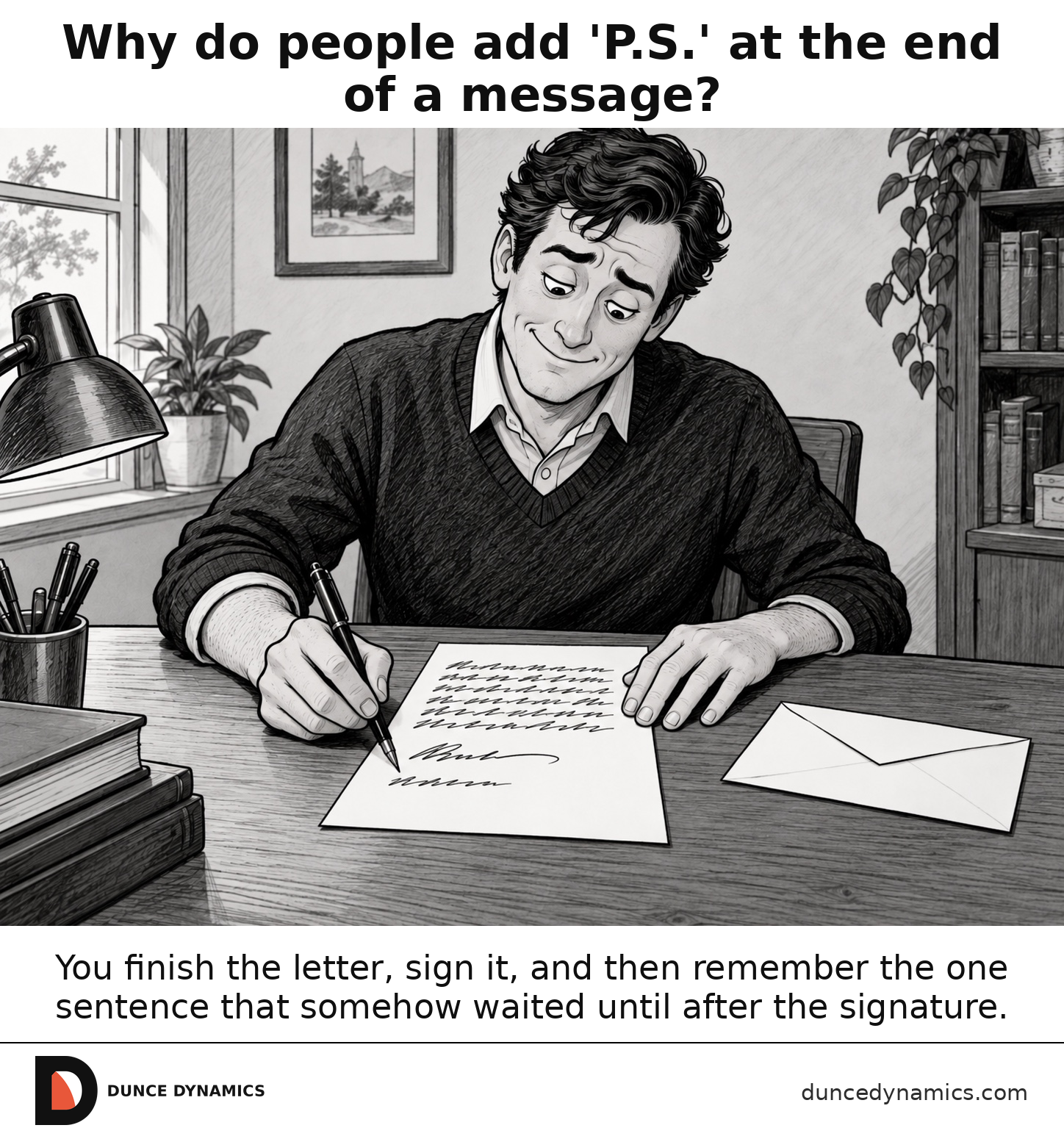
The Dunce Dynamics Institute Examines Why People Ask This
People ask because a P.S. seems unnecessary in email and messaging, where you can simply move the cursor back up and edit what you already wrote. Seeing a leftover convention from physical letters remain common in completely editable digital communication makes its continued use especially noticeable.