
Why do receipts fade over time?
The Real Answer
Many store receipts fade because they are printed on direct thermal paper, which creates the dark image with heat instead of depositing ordinary ink on the page. The paper has a heat-sensitive coating; when the printer's thermal head heats selected spots, the coating changes color and forms the text and numbers.
That image is not equally durable under every condition. Heat, direct sunlight, high humidity, and contact with substances such as oils, alcohol, plasticizers, or aggressive chemicals can reduce the contrast of conventional thermal print. Over time, the lettering can become pale or nearly disappear even though there was no layer of conventional ink to rub off.
Not every receipt uses the same paper or coating, and protected or alternative thermal formulations can be more durable. But for an ordinary thermal receipt, the useful mental model is that the image is part of a heat-responsive coating whose visible contrast can change after printing.
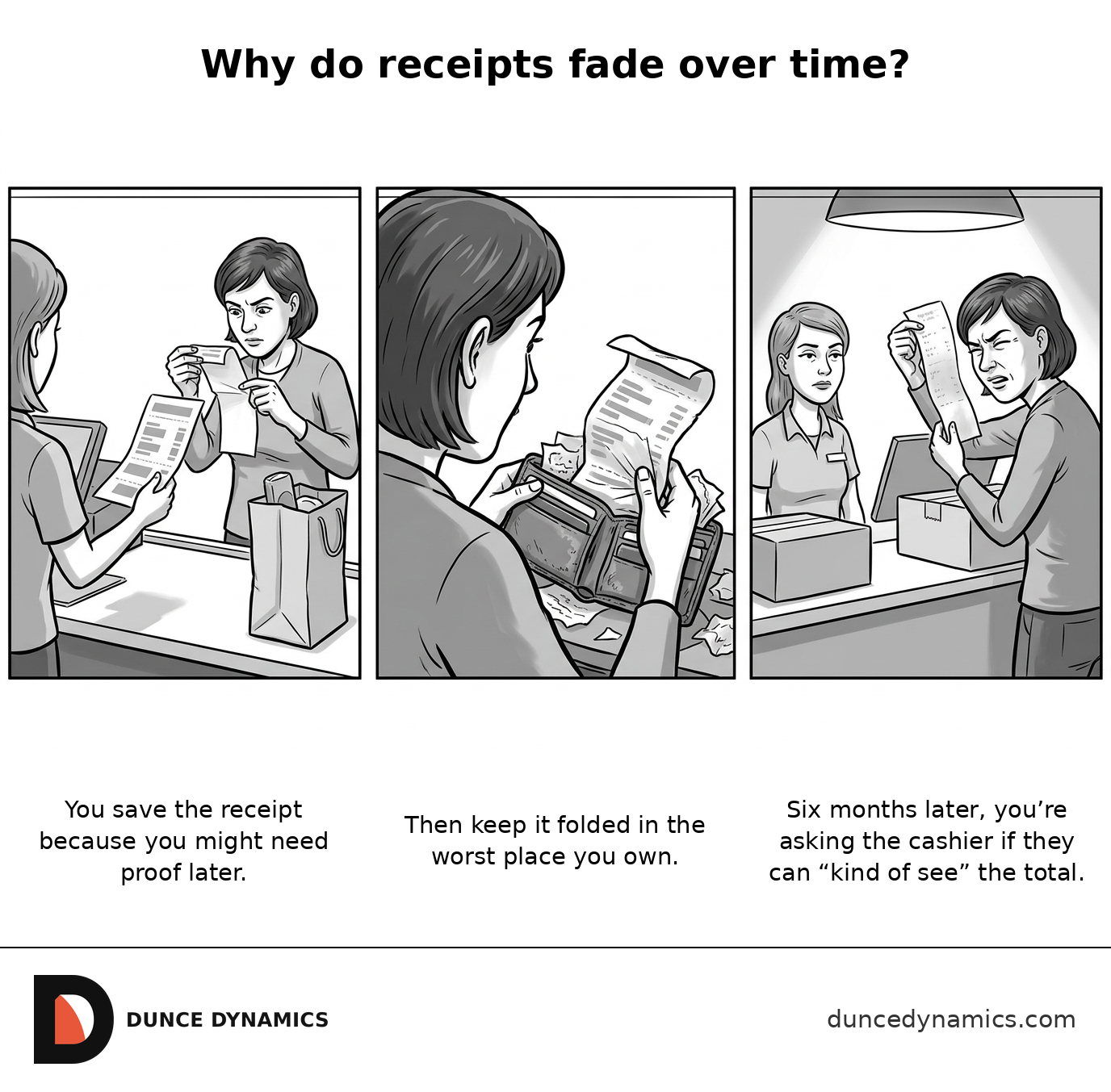
You keep a receipt for six months because you might need proof you bought something, then store it folded in the hottest, grubbiest pocket you own next to your phone and wallet. The day you finally need it, you're at the return counter rotating a nearly blank strip under the ceiling lights and asking the cashier if they can "kind of see" the total.
The Dunce Dynamics Institute Examines Why People Ask This
People ask because receipt text looks like ordinary printed ink, so it is strange when the paper survives but the information seems to disappear. Once you realize many receipts are thermal images created inside a coated surface rather than conventional ink sitting on top, the fading makes more sense.