
Why does a phone charge more slowly near full battery?
The Real Answer
Phone charging usually slows near full because lithium-ion charging changes from a constant-current phase to a constant-voltage phase as the battery approaches its regulation voltage. Earlier in the charge, the battery receives a relatively steady current, so the percentage can rise quickly.
Once the regulation voltage is reached, the charging system holds the voltage near that target while the charging current progressively tapers down instead of continuing at the earlier rate. Charging ends only after the current falls to the charger’s termination threshold, so the final part naturally takes longer. Phones can also slow charging further when temperature controls or battery-health features intervene, so the exact charging curve varies by device and conditions.
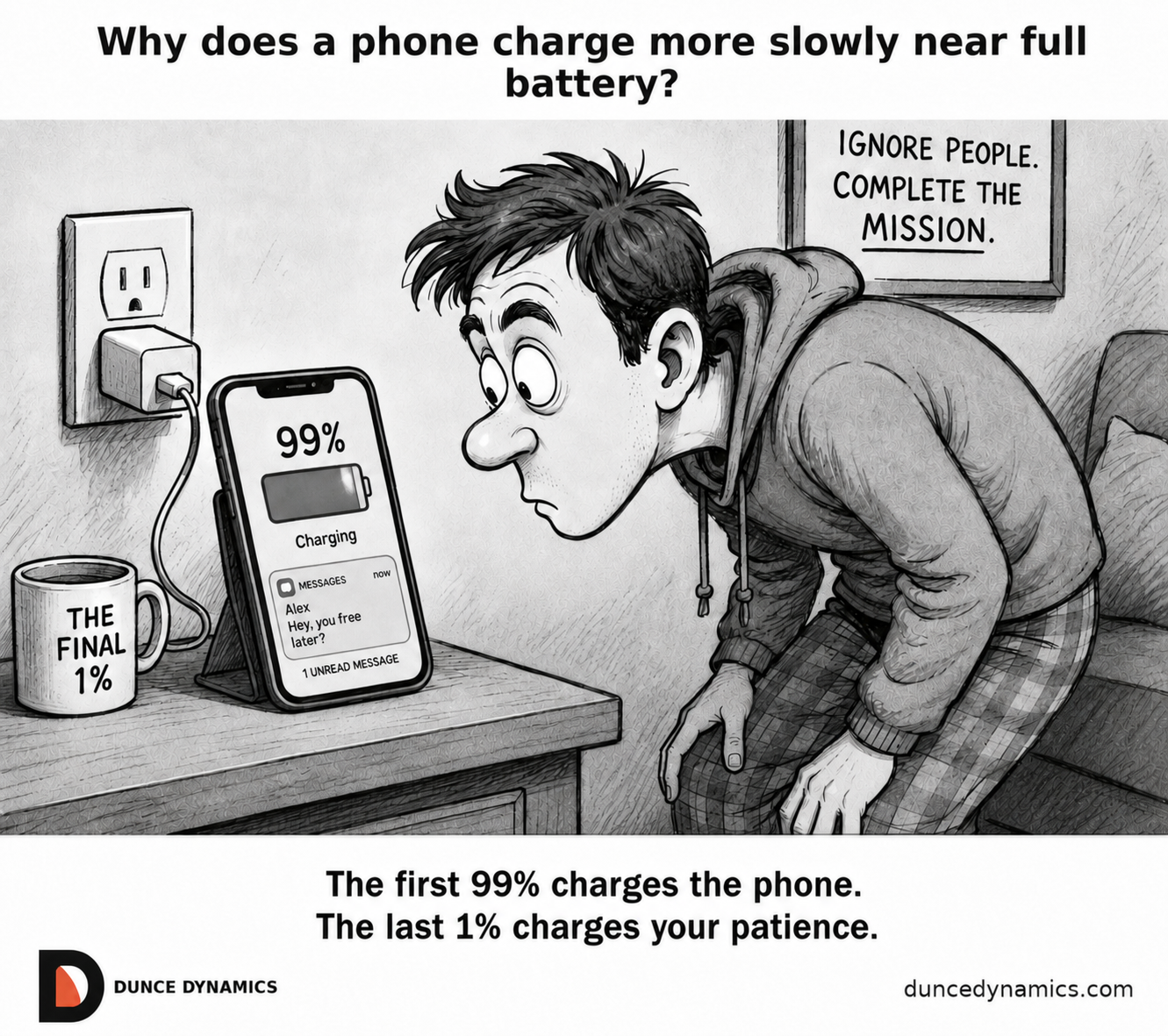
You’ll leave a text unanswered all afternoon, but a phone at 99% gets your full attention. You stand beside the outlet until 100 appears, unplug it immediately, and go back to ignoring the text.
The Dunce Dynamics Institute Examines Why People Ask This
People ask because the slowdown is easiest to notice when the battery meter looks almost finished. Watching the final few percentage points linger makes the end of a charge feel disproportionately slow, even though tapering near full is normal charging behavior.