
Why does hot water freeze faster than cold water?
The Real Answer
Sometimes hotter water has been observed to freeze sooner than cooler water under particular conditions; this is usually called the Mpemba effect. It is not a rule that hot water always freezes faster, and experiments have produced conflicting results depending on how “freezing” is defined and how the test is set up. Factors such as evaporation, heat transfer, convection, supercooling and ice nucleation can change the outcome, and there is no single explanation that accounts for every reported case. So the surprising part is real enough to study, but “hot water freezes faster” is not a universal law of water.
Water is out here playing 4D chess with thermodynamics while you're standing at the freezer thinking about your life choices. The hotter something is, the faster it can become the coldest thing. Physics looked at logic and said 'nah, let's just be weird about this one.'
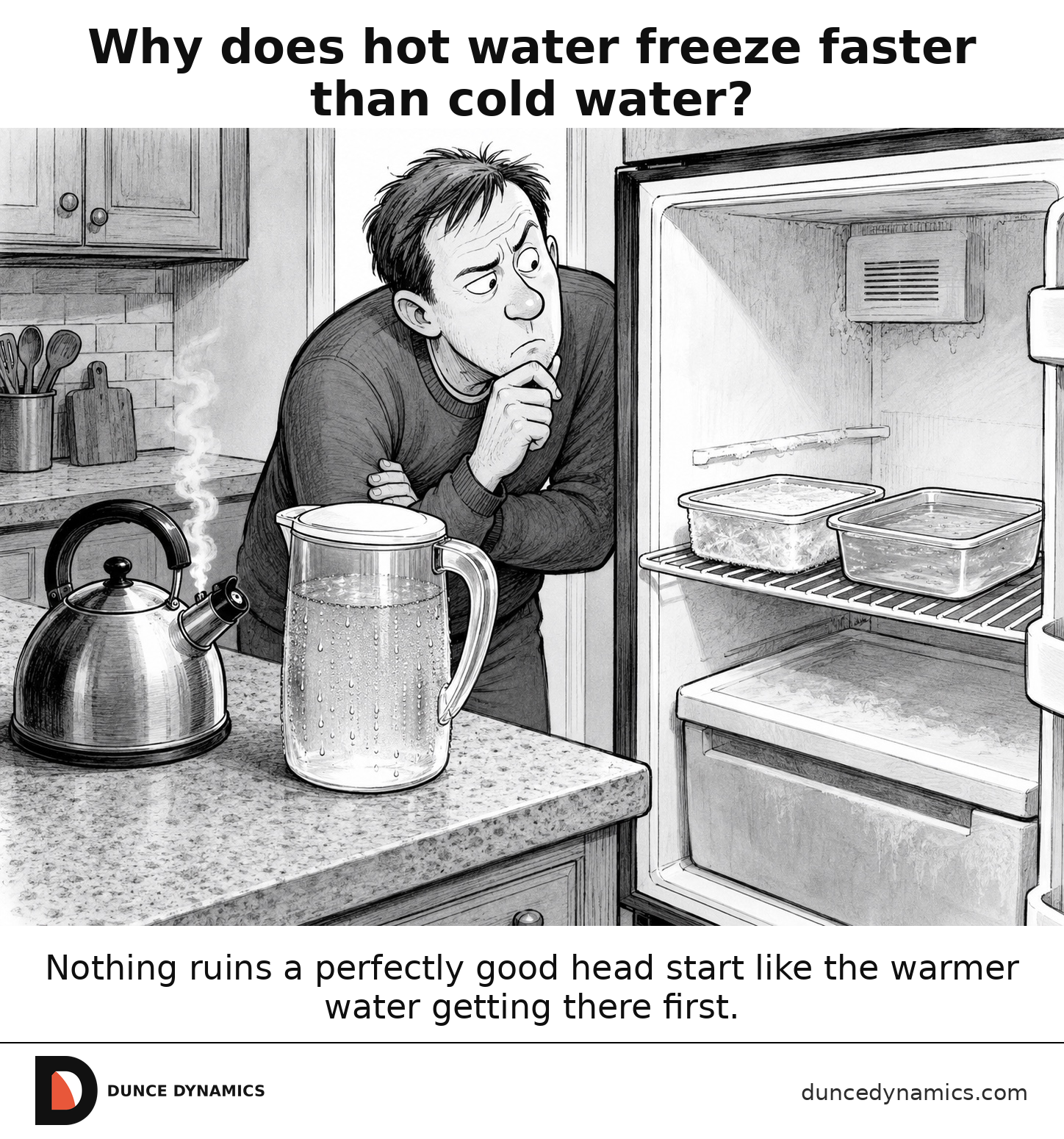
The Dunce Dynamics Institute Examines Why People Ask This
People ask because “colder starts closer to frozen” feels like it should settle the argument immediately. The Mpemba effect became famous precisely because some experiments appear to violate that intuition — and because reproducing and explaining the result turns out to be much messier than the one-line version suggests.