
Why does Wi-Fi get weaker through walls?
The Real Answer
Wi-Fi gets weaker through walls because Wi-Fi uses radio waves, and building materials absorb, reflect, and scatter some of that radio energy instead of letting all of it pass straight through. The signal therefore arrives on the other side weaker than it was before the wall.
How much weaker depends on the material and construction. Drywall and wood usually cause less loss than dense concrete, brick, metal, or materials containing more moisture. Multiple walls can add more attenuation. Higher-frequency Wi-Fi bands such as 5 GHz also generally lose more usable signal through walls than 2.4 GHz.
Walls are not the only reason for weak Wi-Fi: distance, router placement, interference, and the layout of the building also matter. But every obstacle between the router and your device gives the radio signal another chance to lose energy or be redirected.
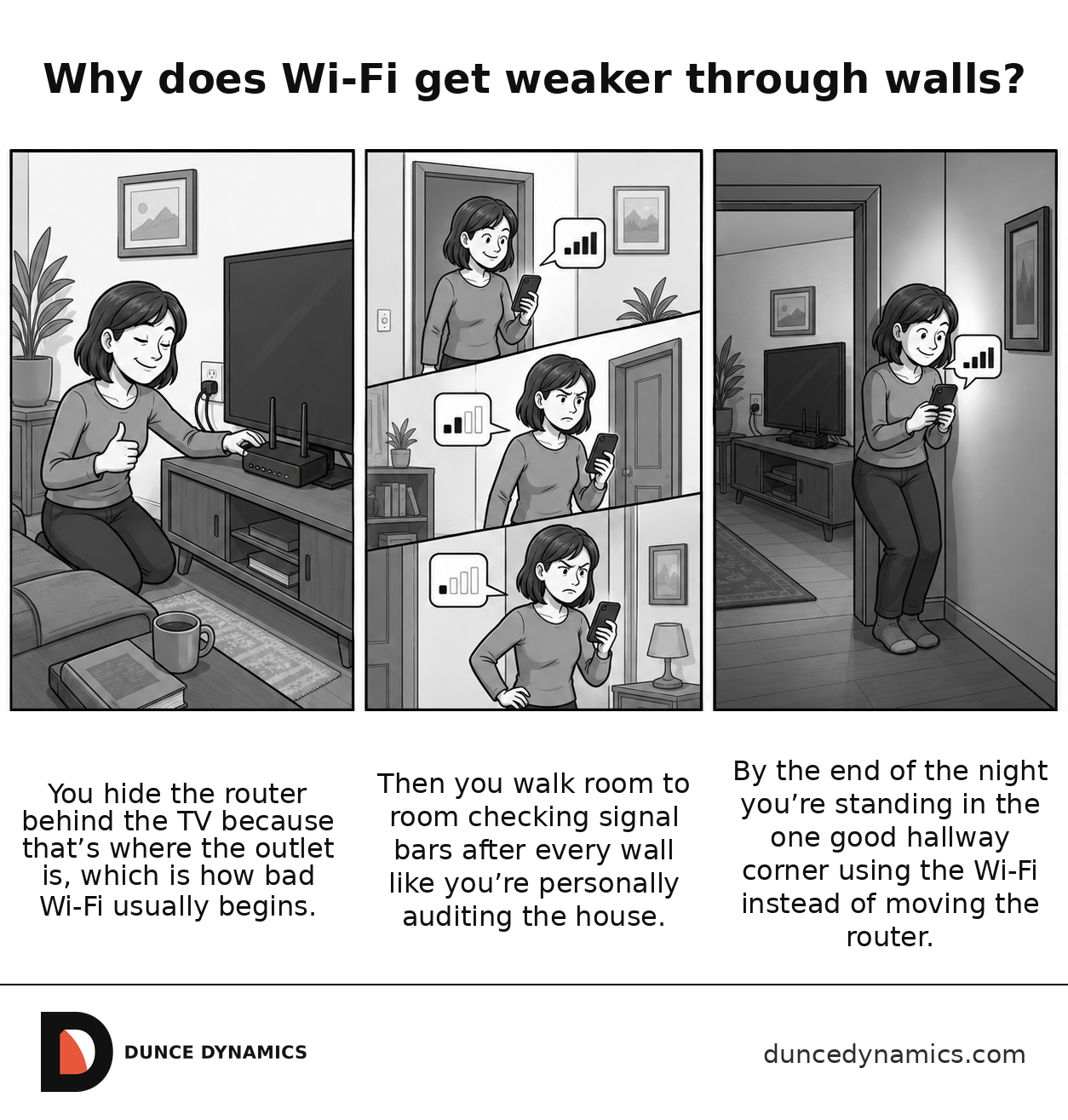
You hide the router behind the TV because that's where the outlet is, then walk room to room checking signal bars after every wall. By the end of the night you're standing in the hallway using the one good corner of Wi-Fi instead of moving the router.
The Dunce Dynamics Institute Examines Why People Ask This
People ask because walls look passive. The same phone can have a strong connection in one room and a weak one only a few steps away, even though the network and device have not changed. The missing piece is that Wi-Fi is radio energy, and ordinary building materials can change how much of that signal reaches the next room.