
Dunce Dynamics Institute
Objects and Systems
Why Are There Empty Tables If the Restaurant Says There’s a Wait?
The dining room looks available. The restaurant may not be. What appears to be a chair problem is usually a table, staffing, reservation, timing, and kitchen problem occurring at once.
Opening Observation
There is a specific kind of restaurant wait that turns ordinary diners into unpaid floor managers.
The host says, “It’ll be about twenty minutes.”
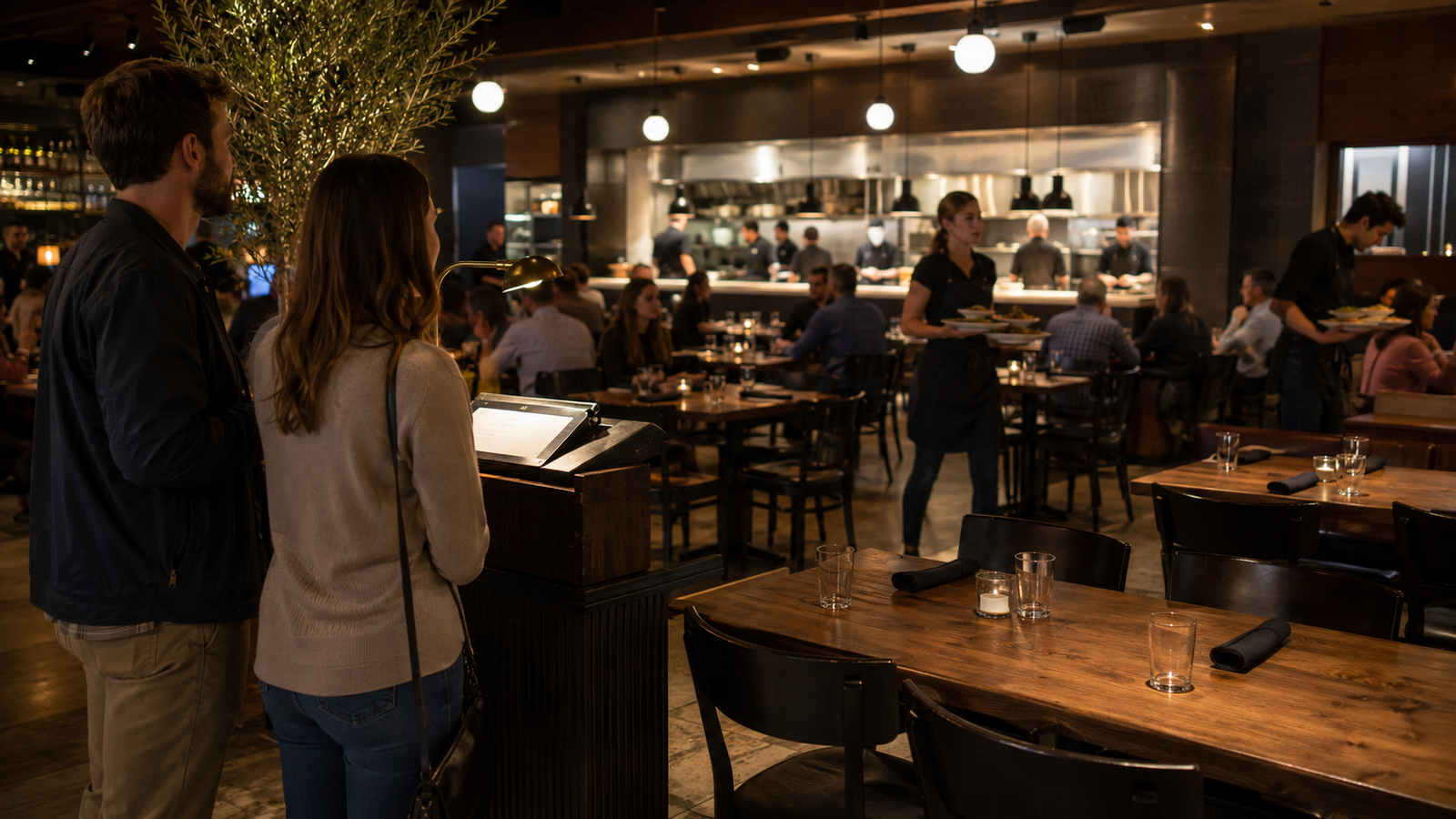
You look past them and immediately find four empty tables.
Not theoretical tables. Actual tables. Chairs tucked in. Menus stacked. Nobody sitting there.
At that moment, the host is no longer giving you an estimate. They are defending a crime scene.
You start doing the math from ten feet away. Two people at that table. Four at that one. There are only three of us. You can physically see the solution. The restaurant, meanwhile, continues insisting there is a wait.
The confusion comes from treating a restaurant like a room full of chairs. If a chair is empty, it feels available.
But a full-service restaurant is not simply selling temporary access to furniture. It is coordinating tables of different sizes, parties arriving at uncertain times, reservations expected later, servers carrying different workloads, meals that do not all last the same amount of time, and a kitchen that can absorb only so much work at once.
That means a table can be empty without being usable capacity for your party at that moment.
The table is visible.
The capacity behind it is not.
The Useful Explanation
An empty table is not the same thing as usable capacity
Restaurant seating is partly a matching problem.
Parties have sizes. Tables have sizes. Some tables can be combined; others cannot. A party of five cannot necessarily use the empty two-top you are staring at, while seating two people at the only available six-top can create a different problem if a larger party is waiting or expected.
Restaurant-operations research treats table assignment as a real capacity problem rather than a simple first-empty-table rule. Table mix, party-size distribution, arrival rate, and whether tables can be combined can all affect waiting time and how effectively the dining room is used.
This creates the first restaurant contradiction: an empty seat can coexist with a shortage of the right table.
The dining room looks open.
The host may be looking at a puzzle that does not fit yet.
A table also belongs to somebody’s workload
Even when a table physically fits your party, the restaurant still has to decide who can serve it.
Full-service restaurants commonly distribute tables among servers or use some other routing system to spread work. Research using restaurant transaction data has found that hosts do not always follow a rigid rotation. They may steer parties toward servers with lower current workload or toward faster servers, especially when demand is high.
That makes sense once you stop treating tables as independent islands.
Seat four parties in one server’s section within a few minutes and those parties do not create four separate workloads. They create four drink orders, four greetings, four sets of questions, four rounds of food orders, four payment sequences, and a growing collection of people wondering why nobody has returned with water.
From the doorway, several empty tables can look like wasted capacity.
From inside the service sequence, leaving one empty for a few minutes may be the difference between a manageable section and a server getting assigned four new emergencies at once.
The kitchen is another queue you cannot see
Then there is the part of the restaurant behind the wall.
Every seated table eventually becomes an order.
If several parties are seated close together, their orders can reach the kitchen close together too. Restaurant revenue-management research has found that table configuration, service processes, meal duration, and kitchen operations can all affect how many guests a restaurant can serve effectively during a busy period.
That is why adding another occupied table is not the same as adding another unit of service capacity.
A restaurant can have enough chairs for you and still be short on the ability to serve another party well right now.
This explanation is deeply unsatisfying when you are hungry because the table is visible and the kitchen backlog is not.
The visible evidence says, “There is your table.”
The invisible system says, “There are already a lot of things scheduled to happen before your entrée.”
Reservations make empty tables look especially suspicious
Reservations create another gap between what the guest sees and what the restaurant knows.
A restaurant may need to protect a table for a party expected later. That decision is complicated by late arrivals, no-shows, uncertain meal duration, and the question of how long a reservation should be held. Cornell reservation-policy research documents these timing and hold problems from both operational and customer-fairness perspectives.
The result can look ridiculous from the waiting area: a walk-in party stands near an empty table because seating them there could collide with a reservation expected before that table would likely turn again.
The customer’s objection is reasonable.
The table is empty now.
Restaurants, unfortunately, operate in time as well as space.
A seat can be unoccupied at 6:48 and already committed at 7:00.
The chair does not display its future obligations.
Dining time refuses to behave like an appointment calendar
The system would be much easier if a restaurant knew exactly how long every party would stay.
It does not.
One table eats quickly and leaves. Another orders dessert. Another adds coffee. Another has not seen each other in eight years and has just reached the part of the story where somebody says, “Okay, but that isn’t even the worst part.”
Restaurant operations and reservation management have to account for variation in meal duration because a table does not become available according to a perfectly reliable clock.
So the host is not only looking at the current floor.
They are forecasting a moving floor.
Who is finishing? Who just ordered? Who has paid? Which reservation is arriving? Which table size will be needed next? Which server just got seated? How accurate was the twenty-minute estimate given to the party now staring directly at the host stand?
The host stand is less “take names and hand out menus” than low-budget air-traffic control with bread baskets.
First come, first served is not always first seated
Waitlists add one more source of visible unfairness.
Suppose a party of two arrives before a party of four. Then a four-person table opens. Seating the party of four first can be a better match even though they arrived later.
Research on restaurant waitlist policies has found that guests may view matching party size to available tables as fair, particularly when the restaurant explains what it is doing. That qualification matters because customers do not only evaluate the length of a wait. They evaluate whether the wait makes sense.
A twenty-minute wait can feel tolerable when every table is clearly occupied.
A ten-minute wait can feel insulting when you are staring at an empty booth.
The missing resource may not be a table.
It may be an explanation.
The Dunce Dynamics Examination
Customers count furniture because furniture is what they can see
The restaurant has a visibility problem.
The customer can see chairs.
The restaurant is managing party size, table configuration, labor, reservations, meal duration, kitchen flow, and future arrivals.
Only one of those is upholstered.
So the customer naturally treats the visible resource as the real resource.
There is an empty four-top. We are four people. The case appears closed.
Nobody entering a restaurant should be expected to calculate the current workload in Server Section B, estimate the kitchen queue, reconstruct the reservation book, and decide whether Table 14 is waiting for a party that is seven minutes late.
You should not need a minor in hospitality operations to understand why you cannot sit down.
But this mismatch explains why the conversation can become tense quickly.
The customer thinks the restaurant is withholding a chair.
The restaurant may be trying to protect the next forty-five minutes of service.
Both are looking at the same table and discussing different things.
Being seated is not the same as being served
This is the part that ruins the obvious solution.
The restaurant could sometimes seat you immediately.
Then you could sit at the empty table and wait there instead.
Which sounds better until fifteen minutes pass and nobody has taken the drink order.
Now the restaurant has solved the waiting-room problem by moving the waiting room to a dining table.
The customer does not experience that as progress.
They experience it as being ignored more comfortably.
The restaurant therefore has to manage not only how quickly someone receives a chair, but whether the service system can function after they sit down. Physical table capacity and staff capacity are related, but they are not identical.
A restaurant that fills every seat immediately may look extremely efficient for about eight minutes.
Then every table needs something.
The host may be protecting you from the thing you are asking them to do
There is an unpleasant hospitality paradox here.
The host says there is a wait because seating more parties too quickly may degrade service.
The waiting customer sees empty tables and assumes the restaurant is creating bad service by making people stand around.
So the restaurant can appear incompetent while trying not to become incompetent.
The employee then has to explain this to someone who is hungry.
“Your table is available, but your server is not available enough, the kitchen has its own workload, and another party is expected later” is operationally coherent.
It is also a terrible sentence to hear while holding a pager shaped like a hockey puck.
Reservations make empty tables look guilty
Reserved tables have an image problem because emptiness looks like waste.
A hotel room reserved for tonight can be empty at noon without alarming anyone.
An airline seat assigned to a passenger can be empty before boarding.
But a restaurant table is sitting ten feet away doing absolutely nothing, which makes the concept of future capacity feel personally offensive.
The customer sees a table having free time.
The restaurant sees a scheduled resource.
The table itself contributes nothing to the discussion.
That does not mean the restaurant is always managing it correctly. Holding too much capacity can waste tables. Holding too little can leave reservation guests waiting. The useful point is narrower: current emptiness does not tell you whether a table is truly free for the entire service interval needed by the next walk-in party.
Party size can create a system that looks unfair even when the logic is defensible
A couple waits.
A group of four walks in later and gets seated.
The couple now has evidence.
Names were taken in order. Time passed in order. Then the restaurant visibly violated chronology.
What they may not see is that the newly available table fits four and that seating two people there could consume the only appropriate space for the larger party while a smaller table may be close to opening.
There are legitimate operational reasons to match party size to table size.
Without an explanation, however, it looks like the host has introduced a secret caste system at the appetizer level.
You were not necessarily skipped because the restaurant dislikes you.
You may have been skipped because you arrived with the wrong number of humans.
This is not emotionally better, but it is operationally different.
The real failure is often invisible-state communication
The larger lesson is about systems whose limiting capacity is hidden from the person waiting.
A restaurant can look half-empty and still be constrained.
The visible resource is the table. The limiting resource may instead be a particular table size, the workload of the available server, a future reservation, or the restaurant’s ability to process another wave of orders without degrading service.
People become suspicious when visible emptiness conflicts with reported scarcity.
The restaurant may be telling the truth.
But if the constraint is invisible, the customer has to choose between trusting the employee and trusting their eyes.
Restaurants make this contradiction unusually vivid because the supposedly unavailable resource is sitting right there under a light fixture.
Communication therefore matters.
“We’re pacing the dining room so the staff can catch up.”
“That table is being held for a reservation.”
“We’re waiting for a table that fits your party.”
Those sentences do not shorten the wait.
They give the empty table an alibi.
What This Seems to Tell Us
An empty restaurant table is not a complete measure of restaurant capacity.
Whether a party can be seated depends on interacting constraints: party size, table configuration, reservation commitments, uncertain dining times, staff workload, kitchen flow, and the timing of everyone else already in the system. Restaurant operations literature treats these as genuine table-allocation, routing, capacity, and service-flow problems rather than simply a count of unused chairs.
That does not mean every restaurant wait is perfectly managed. Restaurants can quote waits badly, mismatch tables, underuse capacity, understaff a shift, or make other ordinary operational mistakes.
It means the existence of an empty table alone does not prove that the table is currently usable for the next party without creating another problem somewhere else in the system.
The customer sees the chair.
The restaurant is supposed to see the dependencies attached to it.
So if a host tells you there is a twenty-minute wait while three tables sit empty, the situation may indeed be inefficient.
But “I can see an empty table” is only the beginning of the diagnosis.
A restaurant is not operationally full only when every chair contains a person.
Sometimes it is full when adding the next party would overload, collide with, or misallocate one of the systems required to serve that party properly.
Unfortunately, that definition is difficult to print on a pager.
Sources & Further Reading
- Restaurant Table Management to Reduce Customer Waiting Times
- Behavioral Drivers of Routing Decisions: Evidence from Restaurant Table Assignment
- Restaurant Revenue Management: Implementation at Chevys Arrowhead
- Restaurant Revenue Management at Chevys: Determining the Best Table Mix
- The Perceived Fairness of Restaurant Waitlist-management Techniques
- A Consumer’s View of Restaurant Reservations Policies