
Why do we yawn?
The Real Answer
Scientists still do not have one universally accepted answer for why we yawn.
What they do know is that yawning is tied to changes in physiological state, especially around sleepiness, waking, boredom, and shifts in alertness. The old idea that yawning mainly happens because your body needs more oxygen does not hold up well: controlled experiments changed oxygen and carbon-dioxide levels without producing the yawning changes that explanation predicts.
One of the better-supported ideas is that yawning may help regulate brain temperature or state. Temperature-sensitive experiments support that possibility, and newer MRI work shows that a yawn is not simply a deep breath: it produces a distinctive pattern of blood and cerebrospinal-fluid movement around the head and neck. But those findings still do not prove that cooling or fluid movement is the one universal purpose of every yawn.
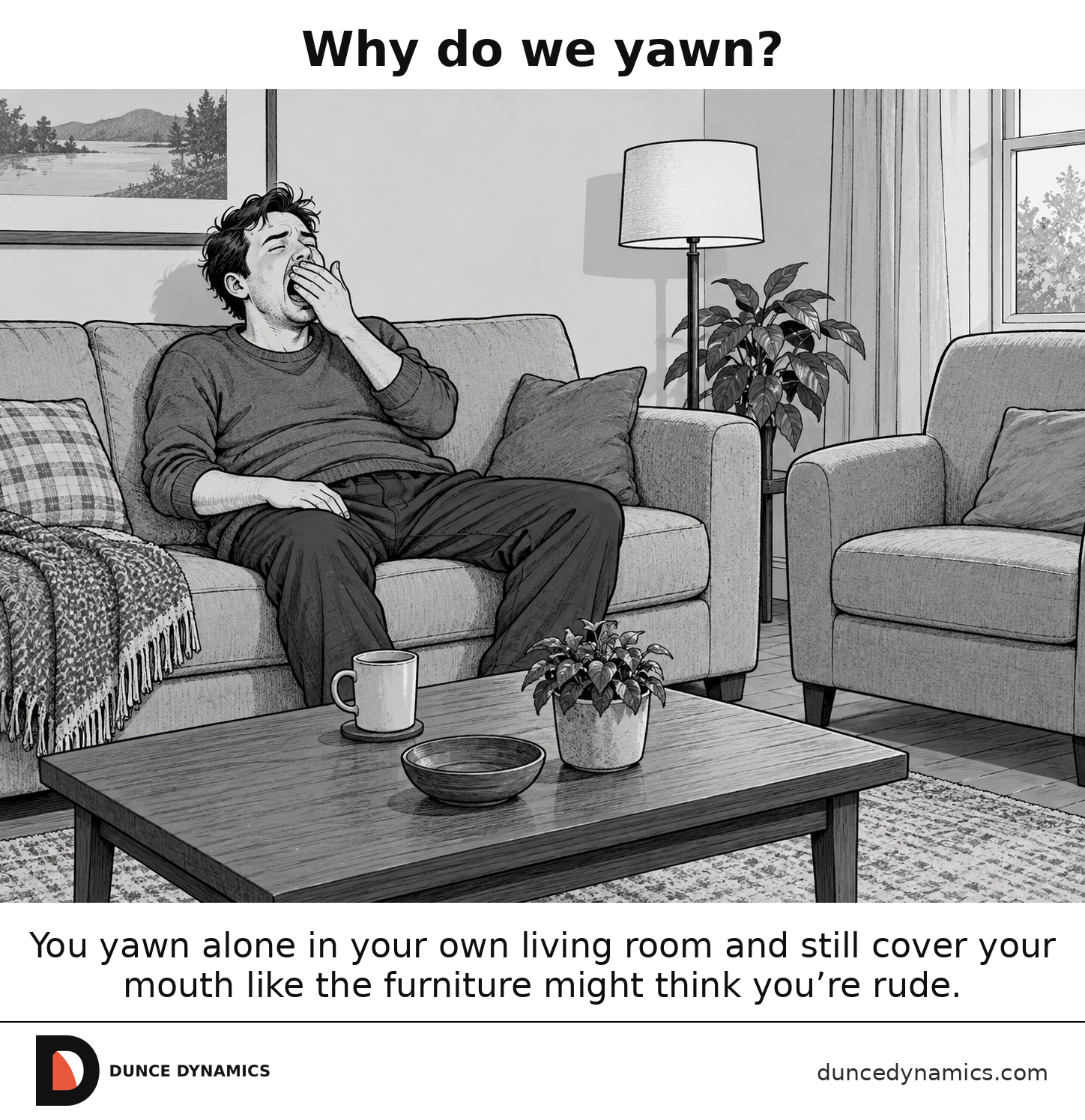
Yawning is one of the few things your body does that you immediately feel obligated to apologize for. You yawn while someone’s talking and cover your mouth so they don’t think it’s their fault. Then you yawn alone in your own house and cover your mouth anyway. The other person left hours ago. There’s nobody left to offend, and somehow you’re still concealing a yawn from the furniture like someone might use this against you.
The Dunce Dynamics Institute Examines Why People Ask This
People ask because yawning feels like the kind of basic body function that should have been solved by now. Breathing moves air. Sneezing clears irritants. Hiccups at least look like something malfunctioned. Yawning happens to almost everybody, can spread through a room, and still manages to arrive without a universally agreed job description.